
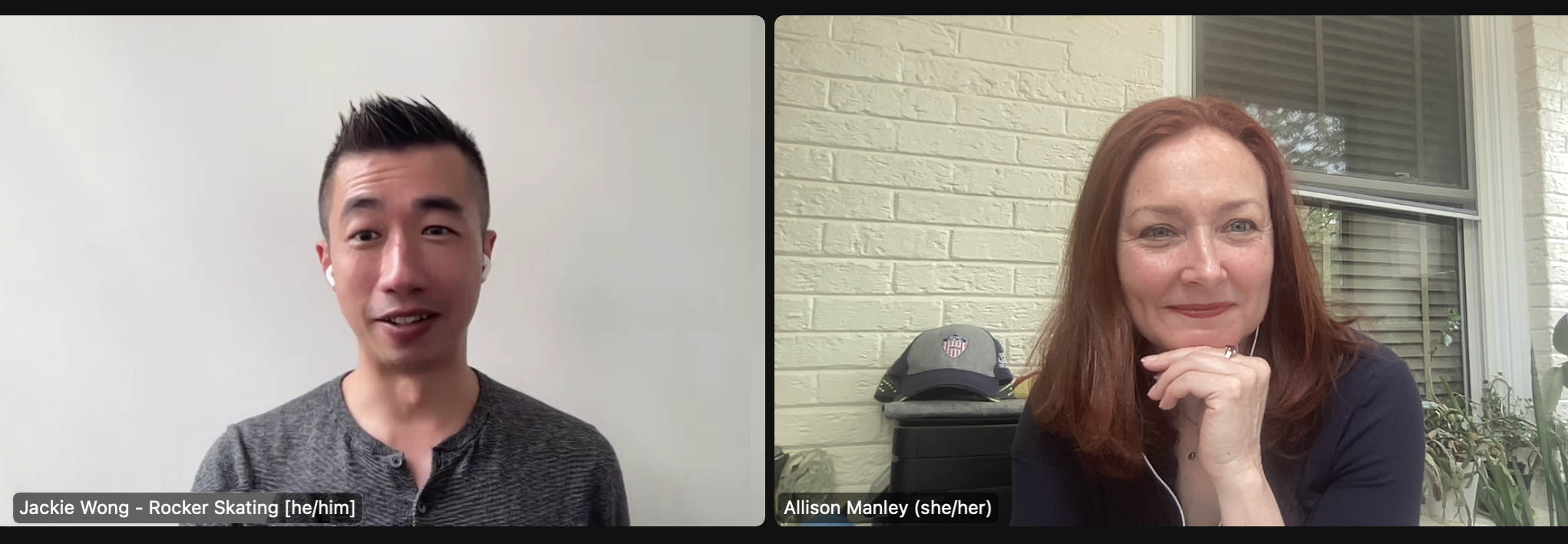
Figure Skating podcast. Ice skating analyst Jackie Wong’s website at rockerskating.com is the top source for the latest news about the sport. But most critically he has a deep understanding of the judging system, which makes him an invaluable resource for those trying to understand the outcome of scores and placements. 1 hour, 1 minute, 45 seconds.
A full transcription is below.
(JW: Jackie Wong, AM: Allison Manley)
AM: Hello skating fans, and welcome to the Manleywoman SkateCast. I’m your host, Allison Manley, and this is episode 86 with skating analyst Jackie Wong.
Jackie began his career as an architect. Currently he’s an Engagement Manager at McKinsey and Company, with a focus on diversity, equity and inclusion research. He himself skated for more than 15 years and went on to both coach and judge the sport. Then he started doing skating analysis and play-by-play online. And over time, grew an online following of about 51,000 Twitter followers, and it continues to grow.
And finally, after spending years building up his reputation, appearing on podcasts and in articles and proving himself to be an incredible resource for skaters and journalists alike, someone at NBC had the good sense to hire him as an analyst on screen. And it’s long overdue, in my opinion, as frankly, I think a lot of the current analysts never bothered to learn the new system in any comprehensive or meaningful way. So it’s refreshing to have Jackie on our screens being able to methodically unpack what the viewers are seeing.
As a side note, he even competed on the TV show Jeopardy in an episode that aired May 19, 2020. In short, he’s smart, wildly talented, has a mastery of data. He’s quick on his feet, and has created something that has become invaluable to skating fans, and has done it in a way that is inclusive, supportive and professional. He’s also got a great mastery of using gifs, which I appreciate. So you should support his website at rockerskating.com to catch all the latest news, follow him on social media, and buy his gear.
And while I’m plugging things, be sure to support the Manleywoman SkateCast in any way you can as well, by sharing on social, telling your friends or sending me a donation via PayPal from my site at Manleywoman.com
This interview took place on May 15, 2022
AM: Jackie Wong, it is so nice to see you again. It’s been many, many years, definitely pre-covid, and it’s been a real pleasure just to watch rockerskating grow over the years and follow along on Twitter. And thank you for doing it, because as a very busy single mom of two, I appreciate being able to just go on Twitter and catch up with everything that’s happening really quickly. So thank you.
JW: No thank you. Thank you for having me.
AM: Well, my first question is, you probably know, for everyone, what is your most embarrassing skating moment on ice or off ice?
JW: Okay, so a lot of lot of on ice embarrassing moments, I think I don’t know if it’s most embarrassing, but certainly one of the most memorable was when I was filming Ashley Wagner and Shae-Lynn Bourne for to sort of do a mini documentary kind of thing on her “La La Land” program, the making of the La La Land program. I was actually on ice with both of them, right, with the camera and stuff, you know, this was like, either pre Jordan Cowan or kind of, at the beginning of Jordan Cowan from On Ice Perspectives.
But I was, you know, kind of, with the camcorder video tipping and luckily, this wasn’t like right at the beginning, but this is like, after a few hours of us doing stuff on on the ice, she was coming down the length of the ice into her flip pattern. And I knew where the flip was going to go, but for some reason I was going left instead of going right. And I was and I was trying to get her in the shot, and all of a sudden I was like, Oh no, Ashley Wagner is gonna crash into me. And instead of me, you know, continuing that pattern having her crash into me, I decided to go as far right as I could possibly go. And I wiped out. So wiping out with a video camera in front of Ashley Wagner and Shae-Lynn Bourne was probably pretty embarrassing to the point where they’re, you know, they kind of had to do a double take being like, you know, actually know how to skate. So yes, there you go,
AM: But you do know how to skate. So let’s, let’s start there. I’ve read that you fell in love with figure skating around the 1992 world championships. What specifically about that event drew you into it?
JW: I actually have no idea, because if you look at the 1992 World Championships, it wasn’t a particularly good World Championships. But you know, when you’re, I don’t know what, what was I like, 10 years old at that point, and I didn’t know what good was, you know, like, it’s kind of like when, when you go to an ice show and somebody does a scratch spin, and you’re like, oh my god, scratch spin. And you just don’t know, what you know actually good is,
I just remember, this was when it was probably like the months after Worlds actually happened. And it was always on syndication, on, like, late night, on some channel. And I would just, can, you know, I would just see it on TV, and I would watch it and and then I would see it on TV again a couple days later I would watch it. So I’d like, you know, sort of pre-obsessively videotaping these programs and watching them over and over again. That was the experience that I got. And every single time I watch it, I was like, you know, oh, I’m finding something else new. This is really incredible. Like to be able to see that I’ve always had a fascination with stuff like diving and gymnastics, and I was like, a general sports fan, right? Like, I grew up in LA, so I was always watching the Lakers, even though the Lakers were terrible in the 1990s.
So, so it was kind of this combination of this, you know, art and sport that I loved about it so much. And, you know, I just became that figure skating fan who would record every single thing and watch it over and over again. That’s how I learned what the jumps were, and that’s how I learned to mimic jumps off the ice, and subsequently, probably contributing to the really bad technique that I brought onto the ice when I started skating, which still haunts me to this day.
So if you’re listening out there and you are contemplating getting on the ice, you know, the 10 year olds who are listening out there, contemplating getting on the ice, do not try to imitate the jumps that you see on TV without proper supervision, because you’re gonna have really bad technique, like I do. But, yeah, that’s kind of how it happened. And, you know, through the years I, you know, I started, I obviously watched the sport more and more. I became a figure skater myself.
AM: And did you take lessons eventually?
JW: Yeah, yeah. So, what happened was, like, for about a year, year and a half, I would just be like, jumping all over my parents living room. And my parents were finally like, I think it was like 1994 they were finally like, “fine, we will take you to the ice and you can go and, like, have a public lesson or a public session lesson.”
And I graduated to getting, you know, actually having a coach and doing all that stuff. And you know, had all of my doubles at some point in my life, landed a couple triples at some point in my life. I was a terrible spinner, and still am. I just like, I’m a weird figure skater, because I never really skated to compete or to do any of the stuff that like a normal figure skater, what they have a coach would do. I just skated because I wanted to do certain things that I really wanted to do a lot of, which was jumping and so, you know, I have a very unbalanced repertoire of skills as a figure skater. But when I finally actually started doing US Figure Skating testing, right, then I started kind of rounding out my actual skating a little bit better. But by that point it was too late.
AM: Yeah, yeah, yeah. As as someone who is still struggling with bad technique on one particular item that I learned many decades ago, it is very hard to unlearn. Very, very hard. But then you eventually did evolve yourself into a coach and a judge. And did that all happen in your teen years, or was that more once you got into college?
JW: That was college. And the coaching was very much me, kind of taking stuff that my old coaches would teach me and kind of translating it to people who already knew how to skate. So it wasn’t as if I was like … one thing I do not know how to do is take somebody who doesn’t know how to skate. I’m more of like a remedial coaching person, or at least I was, and so it was, you know, it was … I did some coaching with, with, you know, friends of mine who were skating in college. And I feel like I can call myself a coach a little bit, basically because I was able to maintain and improve what they were doing, as opposed to, you know, making it worse.
And I did a lot of judging. I don’t know how much your listeners know about the judging process, but there’s a lot of trial judging that has to happen while you are being developed as a judge. And so, you know, during my college years, I would, you know, go and do travel judging, and even into my first grad school years, I was doing some trial judging, and it just ended up becoming too much time commitment, especially when you’re living in a big city and they’re there that the rinks tend to be more in the suburbs, and you got to, like, travel out there and do all this stuff. So so I decided eventually to just, you know, stop doing it. I think I was getting ready to to test for my, like, regional silver judges or something judge certification, or something like that at that point. I’m sure all the names have changed at this point, but, yeah, but I was actually a US figure skating judge in my life, and then I kind of fell out of love with skating for a couple of years, and then the and then the start of Rocker Skating became a thing.
AM: Yeah, so let’s, let’s back up to the college years, because that’s where Rocker Skating did sort of become a thing. So correct me if I’m wrong, because you have multiple degrees, so I’m going to run down your background here and again, just correct me if I’m wrong. But you have three, I think right, you have a BA from Stanford …
JW: I have three degrees.
AM: A BA from Stanford in Economics and Urban Studies. Then you got a Master’s in Architecture from University of Pennsylvania. And at both of those schools, you created skating clubs. So at some point …
JW: That’s correct.
AM: Okay. And then, just to top it off, because you were bored, you earned an MBA from Wharton so you could make a career switch after being burnt out from your career in architecture.
JW: That is all right, that is all correct. And Rocker Skating started in the middle of the third degree, not in the middle of the first two, so I was well into my 30s at that point.
AM: Okay, okay, and which conveniently was when Twitter came along, and we’ll get to that. So on the side you, as you were pursuing your interest in skating, you did start writing about skating first around 2009 for the Examiner. So what? What made you want to begin writing about it?
JW: So as the story will go, I was an architect. I was a junior architect, starting out in 2007 and it was very nice. 2007 everybody was building buildings, and there was lots of stuff. 2008 came along, and the great recession happened, and everybody stopped building buildings. And so, you know, luckily, I was a junior person who wasn’t making that much money at the firm that I was working at, and something. So the Layoff Gods kind of spared me at that point, but still, right? Like, there was salary cuts, there was hour cuts and all that kind of stuff. And I, needed to figure out, like, what could make me some more lunch money? And I was, like, looking at all kinds of stuff. And then stumbled upon examiner.com which at that point was something along the lines of, kind of a Gawker Huffington Post kind of model, where it was a bunch of people who were writing. And obviously, when you’re looking at a model like that, it was about, you know, getting people’s eyes on the content so you can get, you know, web revenue or advertisement revenue, that kind of stuff. So when I first joined examiner.com It was maybe a little bit more exclusive, is the word, but they were definitely very like …
AM: There were niches.
JW: Yeah, and I was the figure skating examiner, right, for examiner.com. And as website grew and, you know, ad revenue became much more scarce, it became much more of a hodgepodge of stuff. But the whole point was, I was trying to make some more money. I had a certain expertise in certain things, and figures skating was something that I’ve always wanted to write, you know, kind of contribute more to and in kind of a larger sense. And that was also when IJS had really become a thing. And so people were trying to interpret the numbers. Mainstream media was probably misinterpreting the numbers, you know …
AM: A little bit!
JW: Yeah. And, you know, for as much as folks who are sports journalists, who don’t follow figure skating all the time, but maybe follow figure skating sometimes, the judging system — at that point, the “new judging system” — was was a little bit of a mystery to them, and they didn’t really know how to talk about it in the right way, right? And so there were some misconceptions that I wanted to, I wanted to be a voice at least, to at least get some people to know that this is actually how you talk about the judging system. Never in my wildest dreams would I have imagined that it would become what what it has become now. Like I was like, oh, maybe I’ll write for a couple years, make some lunch money, and then …
AM: Right …
JW: … go back to my normal life. And I never went back to my normal life. This is now my normal life.
AM: And as we both know, and as many people know, the Federations can only do so much because they are nonprofits stretched very thin with budgets, resources and staff. Were you surprised nobody was doing this already?
JW: No, no, I was not surprised at all. I mean, it was, it’s, it’s a niche sport, right? It’s not like there’s all that much, you know, financial gain to be had to do something like this. And also, you know, when you talk about the Federation, all the Federations are looking out for, or trying to, at least looking out, look out for their own skaters. So you you can’t possibly have a Federation trying to do this and not be, not have an angle toward one specific Federation, which is their own, versus having an angle of like, this is, you know, I’m trying to do this for everybody. Because that, you know, the interests kind of misalign, although I …
AM: An independent third party, yeah.
JW: Yeah, exactly. I gotta say, though, that what US Figure Skating did with Ice Network and making it something of a third party, right, like they were funding it, but it was for the betterment of trying to get more viewers and trying to get content out there, right? Obviously, had all kinds of stuff to do with how the back end works with contracts and media rights and all that kind of stuff, right? But, but there was a, you know, you know, it was, it was an interesting time, right? And Ice Talk, which maybe we’ll talk about Ice talk, the podcast started off as a Ice Network product, which was under US figure skating. But they were very much, you know about talking about international figure skating. But, yeah, I was not, I wasn’t surprised that there was, there weren’t other people who were doing that.
And also, after having done this for so many years, it takes a lot of dedication and a lot of just like anal retentive making sure that you’re covering every single thing kind of time and resources and energy to be able to keep this kind of stuff up. And I’ve seen, you know, other folks tried to cover the skating season kind of as much. And oftentimes what you see is like a burst of energy, and then it kind of burns, right? Or, you know, or it’s sporadic from beginning to end, and you’re not getting quite the same thing. Like the other day … this has nothing to do with skating … but, like, I was, I was looking for, like, where can I find … oh, I was, I was watching the NCAA gymnastics competitions. And I was like, “Where could I find something that could tell me exactly what happened from start to finish?” And I was like, oh, okay, there’s this one site, but, like, not quite what I wanted from all of it. And then there’s this other site, which has, like, some other stuff that I wanted, but so it’s, it’s that sort of conundrum.
AM: And you know, it’s not exclusive to skating or gymnastics at all, because I will say that Friday night, I went to the Yankees vs White Sox game with a good friend of mine, and he we were driving home, and he asked, asked me to look up the box score. And I was on my mobile phone trying to find the specific box score, and it took way more clicks than I thought it would to finally get there.
JW: (laughing) Yeah!
AM: It’s interesting. So you joined Twitter in 2010 and you did start doing your analysis and play by play, and that’s when you were able to differentiate yourself from other skating coverage at the time that was more article-based right? The competition would end. They would write an article with a summary, maybe, but because of the immediacy and real time way that that Twitter gives and fills, you were able to do this much quicker. So was that a gap you were deliberately trying to fill or or did it just happen that way more accidentally?
JW: I mean, I think a little bit of both. I did, one thing that I’ve always loved doing, and like in my regular life, is multitask.
AM: You’re very good at it!
JW: You will find people who hate that I multitask, and then you’ll find people who love that I multitask. But, you know, when I joined Twitter, and it was 2010 I joined Twitter, live streaming of competitions was really just at its beginning. You know, people were starting to consume figure skating in that immediate gratification kind of mode. And oftentimes you would watch these feeds without commentary. You know, you got to love and hate commentary, but there is a lot of there’s a lot that’s good about having live commentary with with figure skating events, or any sports events, because especially if you’re not, like, super deep into the sport, and you’re trying to figure out what it is and what’s going on, you end up trying, you know, you end up relying on that, right? Like, I grew up on listening to Sandra Bezik talking about the World Championships and all that kind of stuff. And so, you know, I was, I was just kind of like, the internet seems a little silent. And there was a lot of figure skating fans out there, right? Even in 2010 Twitter, there was a lot of people who are figure skating fans out there. So, like, what do I do, right? I am very good at typing. I am very good at recognizing things on the spot. I’m very good at doing math on the spot. Why don’t I provide that kind of analysis? And that was, that was absolutely a void, yeah, at that point.
But I also took inspiration from the figure skating forums that were around in the in the 2000 like starting in the 2000 early 2000s era, where there were people literally, you know, there’d be a thread that would be like this competition, and then, you know, you’d see, this is what this person did, and this is what this person did, and, and so,
AM: And there was shorthand that was sort of created during all that time.
JW: Exactly, yeah. And, and so, so that was sort of how all of that got started. And I just realized that one, it was a it was a value add to people who are watching but two, as I did it, more and more, I can’t watch your figure skating competition without typing about it anymore. So it’s sort of become this symbiotic relationship for me. You know, it’s just if I weren’t constantly typing through these competitions, I would not be able to make it through most of them. So it kind of helps.
AM: Well it is good that you are a fast typist. I also love that Rocker Skating was originally a school project as far as the website. You had to create the website for a social media class during your Wharton time.
JW: Well, that, yeah. I think I was, I was alluding to this earlier, the examiner.com was becoming sort of much more of a just a graveyard of lots of, lots of people putting random things on it because they were like, you know, aching for web ad revenue. And so I kind of saw the writing on the wall being like, Okay, well, this is becoming less of a reliable news source. Potentially, it’s probably like the business model wasn’t looking like it was quite working. Let me try to figure out something else. And at that point, I was like, Oh, wow, I had like, 2000 or 3000 followers. Like, yeah, you know, I’ve got, I’ve got enough of a critical mass to kind of do my own thing. Again, not not realizing what it could end up becoming, right? And so I started thinking about branching off of my own brand and the social media class that I took when I was actually in Singapore, at INSEAD, which was an exchange program that was part of Wharton. That was my final project. And, you know the goal at that point, I remember this very clearly. The goal was to get me to 10,000 Twitter followers so, and it was like, you know, how do I think about my brand? How do I think about positioning of, you know, what my value add is to the community and all that kind of stuff. And, you know, the website came out of it. The, you know, all the branding and logos and stuff came out of that, and the rest is history, I guess.
AM: Well, your combination of architecture training gives you an incredible design and artistic eye, but your economics background gives you a mastery of the data and the numbers and the balance of those two in itself is impressive. But what’s most impressive to me, because I know how much time it takes me to do one podcast episode, is the investment of time that you have to make, to do to cover all these events. So I have several questions just around the time investment that you have to make to get this all done. So, and I don’t know if you’ve actually run the math on this, but I assume you have. So let’s see. In an average month, in a non Olympic year, which obviously is its own special beast, right? In an average month, how much time would you say you spend on skating coverage?
JW: I haven’t done exactly the math, but I have estimated this for a number of people who have asked me the same! In a non-Olympic year during the season, usually I would say it’s about 20 hours a week. So between covering the competition, writing previews, doing the podcast, I’m sure there are other things that happen. There were times when I used to do more, right? Like, I would do a preview, I would cover it, I would do kind of a post mortem, and look at it, and I was trying to figure out, like, what is the most value add? People love the preview. So it’s like, Okay, I’ll do that over the post mortem. I’ll do post mortems for for the bigger competitions, but yeah, I mean, that’s what I spend a lot of time on. So 20 hours a week when that happens. When I’m at competitions, I am absolutely doing 15 to 16 hour days,
AM: Right.
JW: Almost almost all the time. And it just goes by in a flash, those those days. So, yeah, it’s, it is a fully half part time job, right?
AM: Yeah, it is.
JW: And luckily for me, it works well, because most of the competitions during the during the season are halfway around the world, and I can do my regular job, and then stay up in the middle of night and do my other regular job and then be completely exhausted on Sunday when I sleep the entire day.
AM: So how many hours would you say then you spend on learning the new rules every year as they evolve and change?
JW: I don’t spend that much time learning the new rules, because it’s often learning on the job in the sense of, you know … I will, you know, for example, after Congress is over this year, I will probably do an article that talks about what the new stuff is. But usually what happens is it comes out of necessity of trying to explain something that happened. And so then that’s sort of, you know, during the season, I’ll be re-reviewing stuff and relearning stuff. I think the thing that for me as I’ve as I have been trying to get myself more learned in ice dance the last few years is especially learning the patterns for the rhythm dance, although this year I don’t have a pattern anymore. But, you know, just understanding that kind of stuff, understanding the changes that happen a whole lot more in ice dance than it does in single skating and pair skating these days. So that’s the kind of stuff that I think prep is spending a little bit more time on. But, you know, changing a half loop to to an euler, you know, changing what the combination addition arithmetic looks like is doesn’t take up that much of my time. So yeah, it is, it is learning on a job.
AM: Okay. And you’ve also been known to cover multiple events, because many times Nationals in different countries will be happening simultaneously. So do you actually prefer to cover them at once and multitask because it saves you some of that time? You’re just doing a huge condensed rocker skating blitz all at the same time?
JW: It really depends, to be honest with you, US and Canadian Nationals, I feel like I always, there’s always this sort of symbiosis with those two that, you know, it’s kind of fun to cover both. I think, Europeans and US Nationals was always a bit of a rough one. Japanese and Russian Nationals have always been like, again, kind of symbiotic, as I’m already up in the middle of night anyway, and I’m not in front of a live competition, so I can, I can look at multiple things on the screen. I do think that when I’m at a competition, I’m trying to cover something else and and it’s like another big competition. That’s probably my whole thing about why Europeans and US Nationals is kind of not very compatible, because there’s just so many skaters at Europeans, as opposed to Canadian Nationals, where you probably will get 10 to 18 skaters right, depending on on what you’re covering. So that changes, or 10 to 18 skaters per discipline. So that kind of changes the dynamic of it. Because when you are, when you — and I mean, I — am in person in front of a bunch of people who are literally skating right in front of me. It’s like, I want to watch that, not like some tiny thing on my screen.
But it has come in handy, I gotta say, in situations where I didn’t expect to do multiple things at once, like, you know, when I was at the Olympics this year, and, you know, there was a press there was like a big press conference going on while the ValievaAM: stuff was happening, while practice sessions were happening, all at the same time, and I was trying to cover all three of those things. My training paid off. I just see everything as sort of just like training for the Olympics.
AM: Your own Olympics, right! And, and I just want to say, you know, it’s always interesting to me that when I see you on Twitter and you you do have those conflicts, right? There’s a press conference, but there’s a practice session, but there’s this over here. And I just want to state: never apologize that you have to drop one or two if something else has to happen, right? Because what you’re providing is fantastic. So if something has to give, something has to give. You know?
JW: I appreciate that.
AM: And it’s also hard enough to follow the rules and regulations for one’s own country’s Federation, and you have to follow them for dozens of countries Federations, because the systems are slightly different as to how they pick team members and team selection, that sort of thing. And again, that takes quite a bit of time for you to learn. Is that also done …
JW: Those are definitely on the job … unless there’s something that I’m seeing that’s gonna affect something coming up like, you know, yeah, even, even in an Olympic year, or even in a regular year, the world selection criteria is, I’ll take a look at for the US, but I’ll take a look at those a couple of weeks in advance, and just make sure that I I’m kind of re remembering them.
There’s just a lot of times when the criteria, even though they’re written on on paper, and the people who have written them on paper have tried to be as explicit as possible, there’s still some version of interpretation that has to happen with them. And so, you know, I think I’m always a little bit afraid that the way that I interpret it, even if it seems very straightforward to me, is not actually what it is that the interpretation is supposed to be. And so, you know, I tried to as much as possible if there is something that that I am questioning or that I am a little bit on the fence about, I tried to get some kind of clarification from somebody who knows a little bit more about it than I do. But at the end of the day, it’s like, you know, I am trying to provide this a service as to the best of my abilities, and that’s kind of how it goes.
I think the worst ones are when it when it’s not in English, and I have to either get a Google translator or get somebody else to translate for me just to make sure that I know what’s going on there. And then things potentially get lost in translation. But again, you know, it’s everybody who’s trying to get the very latest as fast as possible, and I want to make sure that it’s as accurate as I can get it to be.
AM: Right, right. I’m thrilled for you. You’re very fortunate that you have the privilege of working at a job with McKinsey that has a program that allows you to take the flexibility that you need to do rocker skating, because it is a tremendous amount of time that you had to take off for Nationals, Beijing [Olympics], World Championships. It’s really something. So you are, you are really fortunate that you’ve crafted your life in such a way that you can work at a company that says, yes, please go take three months and concentrate on this.
JW: Yeah. It’s kind of amazing. You know, when I started McKinsey in 2015 I was one of the things I was, like, really intriguing. Was like, oh, people take sabbaticals, and you can do it every year? Okay! And obviously, you know, it’s, it’s, it’s a company full of overachievers who are trying to, like, climb the ladder, and not everybody does it, but I gotta say that the longer I’ve been here, the more people have been taking, utilizing that, you know, utilizing that time, and being doing things that allowed them to make this job sustainable for them. It’s like it’s consulting is not an easy life, hours wise and brain wise and stress wise. So anything that gets you kind of away from the craziness of the day to day is nice. And I, you know, it’s been great to be able to do it, because, frankly, I … one it keeps me sane. Two, it keeps me kind of working on this passion project that I that I love. Who knows how long I’ll be able to sustain this? I said that in … I mean, when I first started business school in 2013 I remember, very distinctly, remember tweeting out, “you know, I don’t think I’m going to have that much time this year. I my coverage is probably going to get, you know, less, less, less comprehensive this season,” and then it actually got more comprehensive that season. It was very weird how it all happened. But, yeah, I don’t, I don’t know how much longer I’m going to be able to do this, but I hope, I hope I can do it for a while.
AM: Yeah, selfishly, I hope so too. Well then, of course, I mean, we’ve, we’ve covered the time pretty well. But there’s also the financial investment, right? Because there’s all this equipment you have to bring with you, not to mention travel costs, hotel, food, … even if everyone is buying you chicken nuggets, there’s still food that you have to buy for yourself, and that adds up. So let’s talk equipment. I can take a guess of what you need to pack with you to do events the way that you do them, but I’m sure that my list would be an incomplete list. So what, what is it that you bring with you to events?
JW: Surprisingly, not that much. Surprisingly, I don’t need that much, right? Like, if I, if I were to strip it all down and and be like, what do I absolutely need? I need my phone and I need my laptop, right? Like, that’s all I need. I do bring, I do bring two laptops with me, and I do bring a separate monitor so that I could cover multiple things. And you know, more monitors are better than one. That’s usually my thing, right? My phone can act as my recording device if I do interviews, you know, so a lot of that, right, and you know, when I, you know, try to be an amateur photographer, which I have, which I have done here and there for, you know, during practice session stuff I, you know, that’s my phone. I’m not bringing any anything else with me there. But I gotta say, the packing of all of the clothes that I need to sustain a cold drink for an entire week and not look like I’m wearing the exact same thing every single day, that that actually takes a little bit of effort.
AM: So the bigger effort is in the clothing.
JW:
Yeah, I think so.
AM: All right, that’s fair. And I’m going to assume that for years, you’ve had to pay for this yourself with help from selling some Rocker gear. But I’m assuming that doesn’t cover everything between travel costs, etc, etc. I read in an article once that you’ve used a lot of airline miles over the years.
JW: Yeah, lot of airline miles. Love Hotel points. I mean, you know I don’t want to do this to make it some kind of like, you know… I don’t want to put my stuff behind a paywall, right?
AM: Right. Same.
JW: Even if I did, you know, if somebody is looking to spread the stuff that I’m doing, they could just copy and paste stuff, right? Like, I’m not going to do that. And also I like, I generally try to not be like, “hey, here’s a GoFundMe. Give me some money,” which is why I do the gear, because at least you get something back. I mean, I think it just depends on what people’s preferences are. I know people have, you know, in many years asked me, like, how can I support this? And I’m more than happy to have folks help support it. But ultimately, you can support, great. If you can’t, great. I’m providing you with a service, and if you want to, if that means you’re going to watch more figure skating, then my job is done. So that that’s really the main thing.
I am fortunate to be able to, you know, cover this stuff with my own money, right? But also, the support does help, and I’m very grateful for all the stuff. You know, there’s also just the fact that, you know, I have, I have sponsors, right? John Wilson Blades is my sponsor, and Edea Skates is my sponsor, so that all of that kind of goes toward the expenses that I got during this, during the season. And, you know, I generally break even, and if I don’t, if I, if I somehow make a profit out of it, I will usually take that, I will always take that profit and put it to something right?Probably US Figure Skating Memorial Fund, or something that benefits skating back. So that’s kind of how I think about it.
AM: Well, as you mentioned earlier, you did end up evolving from Twitter and then eventually into the Ice Talk podcast, which is a video podcast in addition to being an audio one, right?
JW: It’s a little, it’s a little video-y. We don’t, we don’t, we don’t quite … you know, the videos are just more for clips …
AM: Right
JW: Then anything you know. It’s nice to have that as multimedia.
AM: Right, but, but doing that podcast on Ice Talk is a very, very different beast than doing mainstream media with NBC and having a co host like Brian Boitano, for example. Was it tough for you to transition to being in front of the camera when it was being in front of the camera as an NBC analyst?
JW: It was very interesting. So I gotta say, if I, if that were … if Beijing, when I did Olympic ice, was the first time I had ever been in front of a camera or talking about figures skating ad nauseam, I would have flopped on my face, much like how Nathan flopped on his face during his step sequence at the very end of his nationals program, which apparently I caused. But I’m fortunate enough to have had the “training”, because, you know, Ice Talk started in 2017 yes, … no, 2016. And the the executive producer or editor at at ICE Network, Mickey Brown, was was sort of kind enough to give me a shot at doing something I’ve never done before, which is, you know, verbally talk about bigger skating in some kind of coherent way. It was always, you know, me typing right behind a computer. And you know that that led to me kind of co-hosting the whole podcast with Nick Carvill. And it just, it got me a lot of practice to formulate my thoughts, to try to be succinct, which I’m not always but, you know, just talk about figure skating in some kind of intelligent manner that is at least some somewhat accessible, especially accessible to fans, definitely, but somewhat accessible to people who aren’t like hardcore fans. So that, that was my start, right?
But then, you know, Ice Network also then gave me a shot at Ice Desk, right? Those live sort of video analysis things that that happened a lot during, during us finger screen competitions. And I was actually talking to Nick Carvill the other day about this, the first time I was on ice desk, I was clutching my microphone so tightly, and I was so, like, just generally nervous about having all these lights in front of me and doing this stuff that at the end of my first segment, I, like, took the microphone off, and I realized it was just like a puddle of sweat that was just on my microphone! And again, if I hadn’t done multiple of those Ice Desks over the years, and become much more comfortable in front of a camera, right and in front of being able to look into something without any sort of audience reaction whatsoever, and like there’s no visual cues as to whether people are understanding you or not understanding you, and having those unknowns in your head and being able to still do the things that you’re you’re gonna do. If I hadn’t had all that, my I would not have been able to do Olympic Ice and and, you know, if I’m being honest, it’s kind of crazy that NBC took a shot at putting me on to do something like this, because I, you know, they’ve seen my reels, right, like they know what I’m capable of doing, but also I’ve never done this before in a real setting.
So that was an amazing experience, and also kind of showed me that I actually can do this. And I will tell you the [Kamila] Valieva doping scandal got me plenty more airtime and practice that I didn’t think I was going to get … all these other TV networks and stuff that were reaching out to me just to talk about figure skating. It was just like, wow, scandals at hand. So it was a very interesting time at the Olympics, for sure. But, you know, I just, I hope to be able to get more opportunities to do stuff like that, because I feel like that is, this is what I am. I have trained all these years to do, right is to talk about figure skating in an intelligent way on a dime.
AM: Right. But it is a very different beast trying to do typing versus on camera, and especially when you’re on camera talking into what is essentially a void, you know? Because you can’t see reactions and you can’t gauge, you know, all of that body language, right? So it’s very it’s a very different animal altogether. But you did a beautiful job.
JW: Thank you.
AM: Yeah, I watched every single one of them during the Olympics, sometimes a couple days late just because of scheduling, but thankfully it was on the replay.
JW: I appreciate it. I appreciate it.
AM: And is not really a question, but more of a statement. I just wanted to make sure I got this in. But one of the things I really appreciate about you as well is that not only are you doing all of this without a paywall for free to listeners, just for the good of spreading figure skating to the masses. But one of the details that you provide that I so so appreciate, as I live by my Google Calendar, is that you’ve created a Google Calendar of all the events that people can subscribe to! So that it’s just on their calendar at all times and they don’t miss anything. And I can only imagine, with your mastery of the time zones at this point, you know that it’s, maybe it doesn’t take so long for you to put together, but I know it’s very well appreciated, at least by me.
JW: No, thank you. I just remember having every single competition I was like, I’m going to tweet out all the time, like, “well, why don’t I just have a calendar that people can subscribe to?” There you go.
AM: Yeah, there you go. Well, it’s true. It’s a good add on. Let’s put it that way, yeah. Well, I do know that Phil Hirsch, who’s the longtime skating journalist, happily considers you a very valuable colleague and is very impressed by your work. I’m wondering if actually, any of the other journalists have not been so generous. Has anyone ever felt threatened by what you bring to the sport? Do they feel like that they, I don’t know, like jealous that they didn’t learn it as well as you did? Or what?
JW: I mean, if it was, if anything was ever said in front of my face, I never heard it. I What’s interesting. I think the I do think the figure skating media community is very, very tight knit, because we are a small community. And I often wonder, like, you know, when, when some of the folks who are, who have been sort of stalwarts of figure skating media retire, like, who’s next, who’s going to be sort of replacing them? And I think that’s that’s or filling the void, not replacing them, right? But I I’ve never felt like anybody was like, Oh yeah, you know, you don’t deserve to be here or whatever. I’m sure there are people who think so. But among the media that’s out there, we all are helping each other and all that kind of stuff. I, you know, I’ve never really seen any kind of, you know, nobody’s threatening anybody else, because I don’t think people are stepping on your shoulders toes too much, right?
AM: Yeah, you’re all doing different things.
JW: Yeah, we’re all doing different things. And you know, even if we’re doing the same things, there are more people who are looking at both of the things, right, as opposed to just like, taking in one source. So, you know, it’s not like me putting together a podcast is preventing other people from putting together their own podcast and and listening to it. So that that is, that is a thing. But I do think, because figure skating media community is so generally small, that that people do go out of their way to try to help. I mean, you know, people ask me questions and I will answer them. It’s not like, I’m like, Oh yeah, I have this, like, information that I have gained through my years of doing this that I’m not going to give to you, like, if, if it is publicly knowable information, if it’s something that that that I am not entrusted with and trying to guard, right, like, I’m not gonna prevent people from having that information.
AM: Yeah, you’re just gonna surface it quicker and in a more accessible way. Yeah.
JW: Potentially. [laughter]
AM: That’s the idea. So with everything you’ve seen across all the federations, all the politics, the skaters, the rinks, the way competitions are run the judging system … what would you say, looking at all of this now, what are the top three things that you think need improvement or change moving forward? Because I was going to ask you the one thing, but I don’t know. I thought that was too limiting. So I thought I’ll give more!
JW: I mean, there are always things, right? I. Yeah. And as as as much as people hate on the on the judging system, I actually am more about the execution of the system than the actual system itself. I think there are a lot of things that the actual system has created or is created with that are generally sensible. And if you, if you used it correctly, it’s the way to it’s going to get you the right results. And for the most part, right like the I keep saying like, 95% plus of the results are what they should be in most people’s eyes.
But I think there is something about the way that the system is used that could be done better. And, you know, I sometimes I go back and forth on this, because I’m like, you know, these are, these are judges who’ve done these things for a long time, like, you know, what is it that they are seeing that I’m not seeing that is leading them to provide these kinds of scores, or those kinds of scores? And then there’s also, like, I very much come into figure skating from a point of view of having learned it in the US, and with a very US point of view in terms of the coaches I’ve, I have taken with, and, you know, the influences that I have, right? And what does it mean to be a good skater here in the US could be … is different than what it means to be a good skater in some other country and I think about that a lot in how I how I talk about how people judge. It’s a very long winded way of asking your question, but I think the system could be used better, and I don’t have a right answer to it, because if I did, I would have told people already.
But, you know, I do wonder, right national politics or favoritism, or what have you like. I don’t, I don’t really know how you would, how you solve that outside of, you know, telling people, these are skaters from different countries that are that they’re not like you’re always going to have that kind of bias, no matter how you slice the pie. And I just wonder how figure skating is going to continue to evolve, especially with, I think, with the judging system being a more reactive thing than it is a proactive thing. Because you just never know what’s going to happen the next year, right and then, and then, all of a sudden, you’re going back.
On a less super serious note, like, I would be really excited for the rink to be used, not like a dance stage, which has always been in the sense of, like there is a set of judges on one side of the rink, and you’re performing to that set of judges, even though there are a whole bunch of people in the rink that are watching you from all angles, like I would love for the judges to be spread out completely around the rink and have different points of view, and frankly, that that would completely change the way that programs are choreographed, because you are not now choreographing to the judges side, right? And you’re trying to be more holistic in the way that you’re doing it. I think the program would feel very different.
AM: It would be logistically challenging to do it, but it is possible.
JW: Yeah. Very, very logistically challenging.
AM: Yeah.
JW: I think … I would just love for there to be, I would love for there to be more more respect in the figure skating fandom world.
AM: Okay.
JW: That is a Pandora’s box that I am not going to open here. [laughing]
AM: I was wondering where you were going with this specifically. But yes, I think I’m reading the lines that you’re not saying.
JW: I mean, there are a lot of there are a lot of things that are that are that are out there, and a lot of fan bases that are very fervent, and that is what happens in every single sport. And it is a good sign in the sport that there are fandoms and all that kind of stuff. But, like, maybe don’t take the sport that seriously, because this is entertainment, and it’s, you know, it is people’s livelihoods, also people’s lives, that you’re that, that you’re looking at. And, yeah, there’s, there’s a lot, there’s a lot out there. And it’s easy to get caught up in something like that. And, yeah, that’s a conversation for a different day.
AM: And that’s, that’s such the fascinating yin and yang of social media, right? Because you can do so much good with social media, with the play-by-play, and with the sharing of the information. But there’s almost so there’s, there’s also that risk of abuse of social media for sure.
JW: Well, yeah.
AM: Directed at skaters, directed at other fans, directed at federations ….
JW: Totally. But also like, like, these skaters and do anything to you, right? They’re also like, teenagers and like, I mean, there’s, it’s, it’s a lot. So I just, I just hope that people get off their soap boxes a little bit and realize that, hey, human beings, hey, this is not that serious.
AM: Right? Well, we’ll end on something a little bit nicer than that,
JW: Please. Let’s do! I took that a very different you went you wanted!
AM: You went very dark for a second, but that’s okay. Not everything has to be, you know, Kumbaya, holding hands and wonderful all the time. So my last question for you as as a hardcore super fan of figure skating, because I would definitely call you a super fan, what is your favorite thing about the sport?
JW: My favorite thing about the sport is, absolutely the combination of the art and the athleticism. And I think we do that in figure skating more than in any other sport that has these the two components to it, mostly because one, we like we do that for every single thing that happens out there, right? Like every single program has to have music and choreography and jumps and spins and all that stuff. But two, I just think that has become very intertwined, especially over the past 15-20, years, and then, you know, before that, right? And I think the the the beauty of the sport continues to thrive and also change. And I think that, you know, fresh voices are have have been in in the conversation over the past 10 to 15 years, and I think that’s really brought a new, refreshing look at figure skating that we hadn’t seen before. And I just, I love the evolution of it. I love that we’re not you know, the best thing that’s happening right now is is very different from the best thing that’s happening five years ago, 10 years ago, and I think that’s, that’s what’s really exciting about sport for me.
AM: And what’s I’m gonna say that I lied, and that was not my last question, because I forgot I had one more! What is the best thing for you personally? What’s the best thing that has come out of the whole Rocker Skating experience for you?
JW: I mean, for me, just falling back in love with figure skating, I guess, to be honest. If I take away the the whole thing about just general, like, sending out bigger figure skating vibes to the world kind of thing, right? I mean, for me, like I said, you know, basically it was after Michelle Kwan pulled out of the Torino Olympics, where I kind of fell out of love with the sport for a couple of years, and then I came back to it. And not, I’m not only coming back to it as a fan, as a commentator, what have you, what you, whatever you want to call me as an analyst. I’m coming back to it as a skater again. I never expected to be doing things in my in my 40s that I was doing in my 20s. So it’s, it’s pretty cool and and it, it’s, it’s just, you know, it gives me, gives me another outlet for creativity, for all the things that I that, that I can have, that I never expected to have at the stage of my life. So, you know, sports been very enriching for me.
AM: Well, good. I’m very glad that you’re doing what you’re doing. I hope to see you at Adult Nationals someday with your newfound skating skills.
JW: We’ll see about that one.
AM: And I just want to say I always appreciate not only your Google Calendar, of course, and your coverage, but I always do appreciate how respectful you are of the skaters and the fans and the sport in general. I just think you have found such a nice balance between the facts and some laughter and a little bit of snarkiness and sarcasm and you know, but you always keep it just so polite and diplomatic, and I applaud you for just finding that great balance between the facts and the fun, if I could simplify it down.
JW: I appreciate it. Thank you.
AM: Yeah, well, thank you for joining me on my show.
JW: Yeah, thanks for having me. This was fun.
AM: Thanks for listening. Remember to share, retweet and spread the good works of Jackie and his website at rockerskating.com and if you don’t mind, please spread the word about my work as well at manleywoman.com
Until next time, may you find your own way of contributing to skating in a positive manner. May you love skating with the passion of a Jackie Wong, and because Jackie has seen every iteration, there is never skate Carmen. Bye.
I really enjoyed this podcast with Jackie! He is such a valuable source of information to the skating world and I love following his tweets during the skating season, it really adds a whole level of interest and fun as I watch the events live!