
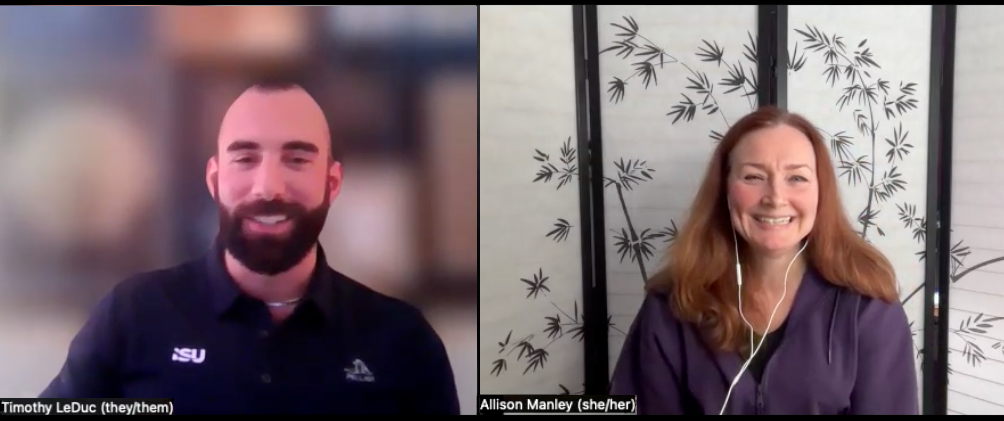
Figure Skating podcast. An interview with American Pairs skater Timothy LeDuc. Timothy is a two-time National Champion in Pairs with Ashley Cain, a 2022 Olympian, and the first out non-binary athlete assigned to the Winter Olympics. 1 hour, 8 minutes.
A full transcription is below.
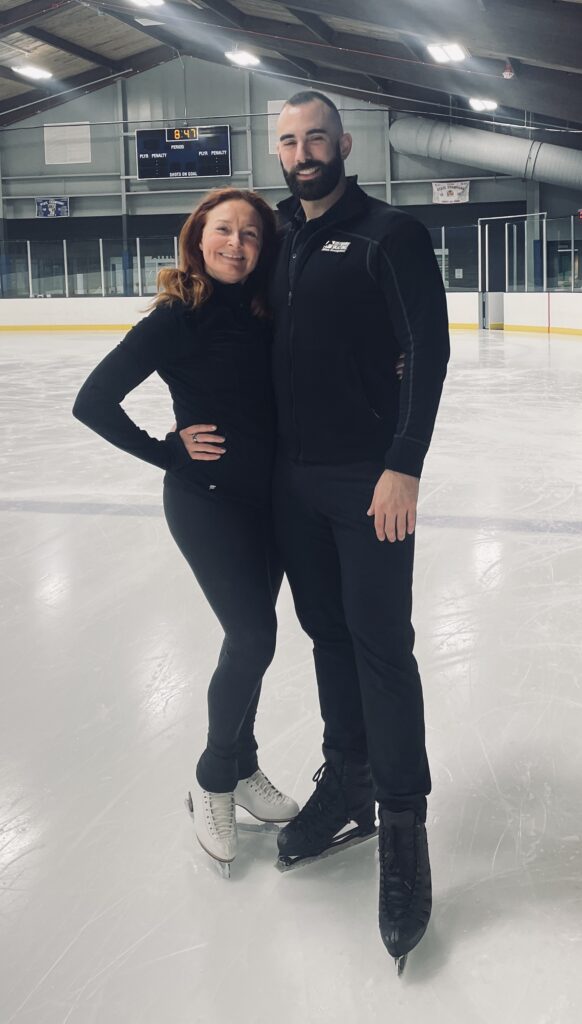
Allison Manley and Timothy LeDuc on the ice at Oakton Sport Complex, November 2025
(TL: Timothy LeDuc, AM: Allison Manley)
AM: Welcome back to the Manleywoman SkateCast. I am your host, Allison Manley, and it’s been a hot minute since I last created a podcast for you all! But an Olympics is coming up in Milan, Italy in just a few months, I am still very involved in the sport as a competitive adult skater myself, having just competed this year in my 21st Adult Nationals, and there are so many great skating stories out there still left to capture. So when a great one comes along, you know, I couldn’t resist getting it out there.
Thanks to all of the fans who have reached out over time to say hello and let me know how much you’ve enjoyed the podcast. I will go months without hearing anything at all, and then, literally, in the past six weeks alone, I’ve gotten three emails, a couple from those who were working on their own skating projects and had discovered the podcast as they were doing research for their own project. So it’s really nice to hear from folks who either miss my show or are discovering it for the first time. Thank you so much.
So here we are back again. And because I live in the great city of Chicago, I am lucky to have access to amazing skaters, one of whom is Timothy LeDuc. Timothy doesn’t love doing any sort of media anymore, but they said they would do it for me, which is very much appreciated. A note that Timothy uses they/them, pronouns, which I will very much honor throughout this podcast.
Skaters train for years behind the scenes, as we know, which is no different in Timothy’s case. However, Timothy’s public career in skating only lasted a short while, just six years in their most high profile partnership with Ashley Cain. Some highlights:
Their partnership resulted in two US National titles in 2019 and 2022 as well as being on the podium four other years. Over the years, they also earned two Grand Prix medals, as well as being champions of the World Team trophy in 2019 and representing the US on World teams … all culminating in their spot on the Olympic team in 2022 in Beijing, China.
For transparency, Timothy is one of my coaches, so I’m privileged that I’ve gotten to know them over the past few years, and it’s never a dull moment. Not only are they an excellent coach, but one of the most thoughtful and nicest people you will ever meet. I am so impressed with how they’ve they’ve been through a lot in their 35 years between the perils of being an elite athlete — which, to be clear, is hard enough, right? Like it’s really difficult! But to also be a non-binary athlete in a world that isn’t always welcoming or accepting is additionally hard. And I’m so impressed with the grace with which Timothy handled and continues to handle all of it, and I think you will be too.
So let’s get to it. This interview took place on November 30, 2025.
AM: You ready to get started?
TL: Yeah, let’s do it.
AM: All right. I am so glad to have you here, Timothy LeDuc, who is also, if I’m going to be very transparent, one of my coaches! So I really appreciate you being able to jump in and do this with me and spend extra time with me off the ice. I appreciate it.
TL: My pleasure.
AM: All right, so first question I ask everybody, and you are no different … what is your most embarrassing skating related moment on ice or off ice?
TL: You know, it’s hard to pick just one. I think the one that stands out to me, off the top of my head, is the opening show when I …. so I skated on cruise ships for two years in the middle of my competitive career. And in the opening show on Liberty of the Seas, I had to do a death spiral with my skating partner on the ship. And we go down into the death spiral, and something happens, we lose our grip. And I’m not kidding, it was like, out of a cartoon, one of those “whoop whoop whoop” when, like, somebody slips on a banana peel. My legs go like, three times before I finally slid back-first on the ice. And I just, I remember getting up, like, you get up quick when something like that happens because the adrenaline and then the pain sets in later, and you realize, like, oh my god, I just like, splatted fully in front of everyone in this opening show.
AM: Did you take anybody out in the audience? I know those rinks are small.
TL: No, no. I mean, my skating partner kind of slid a little ways across the ice, but she was fine. She was already pretty low to the ice. I had the hard time with that one. So …
AM: Well, that’s a first. That’s the first time I’ve heard that one. So congrats on that. I also want to add that before we jump into your career, which I’m going to cover pretty chronologically, you’re the only skater I can think of with facial hair. I have been trying to go back in my memory banks of all the skaters that I’ve read about, or I know, and I cannot think of anyone.
TL: Well, I think there’s, there’s a lot more now, like, I think Danny, Danny O’Shea does, Guillaume [Cizeron] has some, some facial hair. I think it’s just like it was more of, like, something that we started seeing in the 2000 teams, I think, to relax a little bit more. And I, you know, like, once … past a certain point shaving every day, was like, this is hard on me. Like, I can’t do it. I have a lot of hair on my face. So I was like, forget it. I’m actually just, I’m gonna have a beard.
AM: Yeah, no, you’re right, that Guillaume Cizeron and Danny O’Shea, but yeah, prior to your generation, I really can’t think of any just going all the way back (edited: Rudy Galindo had facial hair). And I was really, I mean, I didn’t do a full research project on that, but it was just something I was thinking about. Like, it’s, it’s unusual, but you wear it well.
TL: Thank you. Yeah, it’s just one more way I like, refuse to be anything other than myself, I suppose.
AM: Good for you, as we all should be. So you were inspired. I read from the 2002 Olympics. Can you tell me a little bit about your origin story there?
TL: Totally, yeah. So I grew up in Cedar Rapids, Iowa, and there’s not a lot of figure skating there, and I was kind of doing what everyone else my age did, which was play, like flag football and soccer. And I was not very good at those sports. I sort of did them for the social aspect, but I was, like, yearning for something else. You know, my mom was a gymnast and a dancer, and I was really connected with her on that. I just never, like, I tried gymnastics. It was like, fine, but it never really felt like my thing. And then I saw figure skating on TV, and it just like, it clicked. I was like, that, I need to be a part of this. There is, like, music, it’s athletic, they’re on ice. They’re kissing and crying, and like, I need to be a part of this, like, beautiful, sparkly pageant that is happening on the ice. So it was kind of love at first sight. And they’d just built a rink about a quarter mile from my house that same year, or, sorry, the year before. And it sort of felt like fate. I was like, all right, I think I meant to do this. I could walk to the rink on days when my parents couldn’t take me. So everything just sort of took off from there.
AM: It does seem like kismet that just as soon as you get invested, they built a rink just for you down the street. That’s terrific. Which I’m curious which skaters inspired you in Salt Lake City, because obviously that was the scandal year with the pairs scandal. And I wonder if that put the bug in your ear for pairs, or was it other skaters that were more more interesting at the time?
TL: That’s a good question. I will be honest, my focus wasn’t really on pairs as much. Of course, that was a big story at the time, and I remember kind of watching it all unfold, but I was really drawn to the women’s event. Sasha, Cohen, Sarah Hughes, Michelle Kwan, Irina Slutskaya … that event is … I still go back and watch that final group sometimes, because it’s just, it’s such a great event. The the stories leading into it, the way it unfolded, everything. It really is kind of what figure skating is all about. You know, Sarah Hughes is fourth, and her story is, like, it’s stuff that dreams are made of. So, and I’ve watched that free skate, I more than I care to say it’s, it’s just so magical, you know?
And, of course, I was inspired by the men’s event as well. Timothy Goebel. We had the same name. He started a little bit later in his career as well. He started originally in Chicago. So it sort of felt like this, like a Midwestern skater starting later in life from, you know, Chicago, was like, yeah, maybe I should be doing this.
AM: Okay. Well, yeah, I think it’s amazing that by the time you were discovering skating, you were 12, and you didn’t even start in private lessons until you were 13. And then just seven years later, you’re competing in major events. I mean, were you just naturally talented? Were you sort of one of these wonderkinds once you got there?
TL: It’s a great question, I think …
AM: I mean, you mentioned your mom had a gymnastics and ballet background, so I just wonder if there was some good genetics there!
TL: That certainly does, that does probably play a part in it. You know, you never really know what the genetic expression is going to be for a kid. But I think, I think I did have a lot of natural talent with it, and I think a lot of the reason why I was able to excel so quickly and start so late was because a lot of the skills you need in figure skating, I was already developing. So a lot of the coordination by doing gymnastics and dance and football and soccer and … those activities, I think, were sort of building my athleticism, so I was able to kind of jump into it so quickly. Obviously, it’s better in a sport to start with the sport specific things that you need, but I was able to sort of jump into it quickly because I was very athletic. Yeah, I think I got lucky in that way, and I just probably had a lot of natural talent.
AM: I am going to make a completely, you know, guesstimated, biased opinion that, yes, I think you did have some lucky genetics in there, only because you can be very athletic, but understanding the lean of a blade is a very specific skill. And you really have beautiful edges and wonderful control of the edges. And I’m not sure flag football, you know, quite covers that exactly. No, it doesn’t quite translate. But I think it’s really remarkable just how you were able to start later. And it gives hope to those who don’t start at age four. I mean, there are a lot of kids, you know, you hear a lot of skaters started at age two or three or something incredibly young. But I think it’s wonderful that you were able to start later and get to where you got. So you were a strong individual skater despite starting late. So why pairs? What drew you to pairs?
TL: I think I realized … let’s see, I switched to pairs when I was 19. I think it was my first season in pairs. I think by that point, I sort of realized, if I’m going to make this a career, I really want to keep doing this. I need to do something that I can go to the Olympics in. And I was a good single skater.
AM: Was that a goal at the time?
TL: Going to the Olympics was the goal. Yeah, that’s kind of the only thing I really lived for. And I kind of saw the writing on the wall with singles. I was landing triple Axel, but I wasn’t, it wasn’t super consistent. The quads weren’t really feeling like I was gonna probably have them ever consistently. I was also over six feet at that time, and I didn’t really see any skaters over six feet doing quads. So I sort of like, I don’t, I don’t know if this is going to be the best, the best career path for me, trying to pursue singles. And once you’re in college, the risk becomes higher, you know, because you’re just giving up that much more time that you could be pursuing other things. So the option of pairs was on the table, and I thought, you know what? I’m tall. I have my jumps. I’m a pretty good skater. I know how to perform. I think that I could do really well with this. So I think that was the year I moved to Indianapolis to try to skate pairs full time.
AM: Okay, and your first partner was Cassie Andrews, is that correct?
TL: Actually, it was Lauren Gifford. We did one season in Novice.
AM: No, you’re correct. I’m sorry,
TL: Yeah, no, it’s okay. Lauren and I skated for one season in Novice Pairs, and Cassie and I for two seasons Junior and Senior. And then I skated with DeeDee Lang, who was Junior Champion for two seasons at Senior. And then that’s when I retired and went to cruise ships. Retired the first time, I should say.
AM: Well, I do want to point out that just in nine years, you went from never skating at all to being ninth at the World Junior Championships. I mean, that’s really stunning. It really is.
TL: Hmm, thank you. Yeah, I guess I never looked back at on how many years it took to do that. But yeah, that’s great, Lucky me.
AM: Lucky you. A lot of hard work, though, not just luck. So am I to understand that when you did end your, your pairs career, and you retired for the first time and went to the cruise ships you were skating with your sister?
TL: Yeah, so my sister started skating at the same time I did, because she also watched the Olympics, and was, I think, yearning for the same, same outlet of something that is athletic and artistic. And so she had stopped skating a few years before I did, and it just the timing of it worked out. We were both hired on the same contract to do cruise ships, and we were able to go do them together. And it’s like, still, like one of the best memories that we have, getting to sort of travel around the world together and do something that we loved, that had brought us together. It’s also where I met my best friend, Cordero [Zuckerman]. He was on the contract with us as well.
AM: That’s great. So so I hold on … was it your sister that was in the death spiral that went flying?
TL: No, it was not! No, gratefully, I never dropped my sister.
AM: Okay, so, you know, it is kind of surprising you weren’t a brother, sister team, I guess. But Pairs was not her thing?
TL: You know, we actually tried. We did together a little like pairs program, with, like, some double throws and side by side jumps. But yeah, it just it wasn’t, I don’t think it was right for us. Plus, we fought like cats and dogs. We would never have survived as a pair team. Like, I love my sister, I know she loves me, but like, I think skating together, we probably wouldn’t have worked.
AM: You wouldn’t have come out alive. Okay, that’s fair. And we should point out that your best friend, Cordero is tell us
TL: Also Denali from RuPaul’s Drag Race, yeah.
AM: Amazing. And oddly enough, Cordero, who lives and works in the Chicago area, did program a step sequence for me once, he did choreograph that for me.
TL: Really? Oh, I didn’t know that!
AM: Yeah, I’m trying to remember which program of mine it was. I believe I was skating to the red violin. I had a step sequence that was not IJS friendly enough, and he helped me make it better.
TL: Yeah, Cordero choreographed two of Ashley’s and my programs in 2018,
AM: Wonderful. Alright, well, so let’s go back to the cruise ships real quick, because I know a lot of skaters who don’t make it to the Olympics or they that was never their goal, but they want to travel the world. What was your experience on the cruise ships? What did you get out of that?
TL: Oh, I had a blast. It was such a fun, fun way to skate and to also do a lot of the things I felt like I missed out on in college, in a way of just like the cabins on a cruise ship are kind of like dorm rooms. There’s a party culture. You get to travel around the world. It just, it was a lot of the things that I couldn’t do when I was training and competing, and I always sort of felt like I missed out on a college experience, and that kind of felt like what that was for me and what it served in my life. And just getting to, like, get paid and do something that I loved so much was really great. I was really struggling after 2014 with, like, what to do with my skating, because I I didn’t want to be done on the ice. I just didn’t really want to train. I was really mentally burned out at that point, so having the opportunity to around, to grow as a person, and to have a little bit more experiences in life outside of what I was doing in the rink meant a lot to me.
And then after two years of doing that, I I still felt like there was more to do. I felt like I had that, that desire to do the work again, because the training lifestyle is brutal. It is so hard. It’s so much harder, I think, than people can even really convey or describe. They’re the mental tax it takes, or the mental strain it puts on you day and day out, month after month, year after year, is so, so difficult, and I think some people deal with it really well. You see skaters like Maddie [Chock] and Evan [Bates], who can just they can train and compete and well into their 30s and do it really successfully. And other skaters, I think, really struggle with that. And just the mental strain on me was really, really hard. And that’s kind of why in 2014 I think I needed to take a step back a little bit and take a breath, travel a little bit, do something fun. And then after two years of that, I was like, you know what? I really, I feel like there’s more that I can do. I feel ready to do the work again. And I would have just been really, I think I would always have wondered, what if, and had some regrets if I didn’t give it one more try.
And when I came back in 2016 to skate, I had saved up enough money from the cruise ships that I knew I could train for one season. I had enough money to pay for one season of training. I just wanted to be on Nationals ice one more time and to feel a little bit better about ending my career. Because, like, I didn’t skate great in the free skate at 2014 Nationals, and that was my last competition, and I had enough money to train for one season to have the opportunity to go back to Nationals one more time and skate a better free skate. And then I thought, okay, if it doesn’t work out, if I don’t get a sponsor or funding, at least I tried, and I can leave Nationals ice, feeling better about myself, and then figure out what comes next, whether I go and do more shows or go to school or whatever. But then, obviously Ashley and I did really well at Nationals. We won the short program, ended up third overall, and money came in, enough for me to keep training another, gosh, five seasons after that.
AM: Yeah, I would say that unfortunately, you failed in your mission to only skate one more season because you were just too good! So how did it work out that you were paired up with Ashley?
TL: So she was also looking for a partner at that time. And of course, we competed against each other with different partners, so we knew each other. And then I had talked to the high performance director, Mitch Moyer when I finished my my ship contract, and I said, “hey, I’m going to start training again. I’d like to skate like another season. Not really sure how to go about finding a partner. Maybe you can help.” And he suggested, Ashley. And we had a tryout. And I was like, all right, this, this is going to work. I can afford Texas. I can afford this situation. Ashley also had some time off and had a little bit of, how do you say, like, a vendetta or, like, unfinished business with pair skating, you know? So we both sort of shared in that little bit of like, I’m not really happy with the way things ended, like, let’s give it another shot. And yeah, just kind of took off from there.
AM: And it took off for sure. I know that one of the things that’s very notable about the Cain/Leduc pairing is that your height difference was not that different as compared to some other pairs teams, which, and that’s unusual. Personally, I know I liked the look of it. I know others did it as well, but was it ever a hindrance for you, being so close in height?
TL: Was it a hindrance? I mean, I have to think about the way, the way, when I look at us, like, skate at the Olympics, and you know, the what we were able to accomplish in six years, I don’t think so. I see that a really, really nice, beautiful pair team with really strong pair elements, and, like you said, a unique look on the ice. I think it just took a little bit longer to get there than maybe some other teams. You know, the first couple years, you could just see we were figuring it out. We were both kind of coming back from time off. We both hadn’t really reached our physical peak. Fine tuning your body and mind to compete at such a high level just takes years and years of trial and error. So when I look at the team that we became in the end, no, I don’t think our height difference or lack thereof was a hindrance. It may be just, we just didn’t get to that level as quickly as maybe some other teams. And that maybe isn’t the maybe height isn’t the reason for that. There could be other factors.
AM: Sure, I understand that the triple twist was tough for you for a while.
TL: Oh, yeah, that element. I am so happy I never have to do a triple twist ever again.
AM:
It doesn’t look like it’s anything for you. It looks like it’s …
TL: By the end? Yeah. Or when I see it at the Olympics, I’m like, “that’s a nice twist.” And I know, I know firsthand how much work it took to get that nice twist.
AM: Interesting, that that, of all things, is, is what you consider the toughest of the elements for you as a pair.
TL: Oh, for sure, yeah. And I don’t think that our height difference or lack thereof, again, was the reason. Twist is … if you do it right, twist is very easy. It’s a timing-based element. And it just took us so long to figure out the technique and figure out the timing and learn how to work together to get the height and the spring. But then once we figured it out and we got the technique down, yeah. I mean, it was, it was a lot easier.
AM: Well, I’ve always thought it was interesting that your coaches were Ashley’s parents, Peter and Darlene Cain. He was a 1980 Olympian in Pairs from Australia. Was that dynamic — being coached by your partner’s parents — at all awkward? Or were you all able to compartmentalize business and home life?
TL: Well, we also had Nina Mozer involved pretty heavily. I mean, Nina was our head coach in the way that, you know, she designed our training plan. We worked with her a couple times a week, and we would go train with her very frequently, or she would come to to us sometimes. So we had a coaching team that, yes, had Ashley’s parents on the team, but we also had other input. But, I mean, as far as it being like other family members that were on the coaching staff, I mean, yes, it’s it had … there were challenges. I think there’s going to be challenges anytime you know, a parent is a teacher — like I was homeschooled growing up, so my mom was my teacher. And that, you know, there are unique challenges with that, but it isn’t impossible. And you know, obviously we made it work.
AM: Well, your pairing really brought something different. And as I mentioned, the similar heights was a little bit different all by itself. You also were equally flexible to Ashley, which I think is unusual as well, and you really took advantage of that. As I’ve heard in other interviews, you said that your pairing was really going beyond the expected and the traditional romantic pairings that were out there, and it was more of “two pillars of strength,” as you described it. So I’m wondering if that was something that you decided at the very beginning of your partnership that you were going to approach this differently, or was it something that evolved over the time together?
TL: I think it was definitely something we … I’m trying to think back … what were our programs the first few years?We kind of did that Celine Dion/Andre Bocelli duet our first season, but it didn’t. I never thought of it as romantic. I think we knew from the start that we were not ever going to try to portray romance on the ice. I had done Romeo and Juliet and Carmen with previous partners, and I always was just sort of like, bro, this is not my thing, you know? And I don’t think Ashley was really interested in being … you know, there’s a lot of it depends on on what you’re trying to portray. But a lot of times the the woman’s role in some traditional expressions of gender on the ice is for the woman to be sort of like the weaker one, or shy or demure. And I don’t think she had any interest in being those things either.
And not that those roles are inherently bad, and not that it’s bad when people do portray them or are successful with them, it just didn’t really feel like great for us. I think we were really just interested in being like powerful, strong athletes and creating beautiful skating together so and, yeah, I mean, the two pillars of strength was just sort of, I guess, the way that we tried to brand that image as best we could, yeah, we really took that to the bank.
AM: I mean, it looked like it was much more freeing to be able to look beyond the typical gender norms there and to be able to explore some other areas, you know, within the skating itself, because it … you’re right, that there’s, there’s plenty of Romeo and Juliet and Carmen in the world. So it’s nice that you were able to explore different things. And her wearing a unitard, I think was part of that as well.
TL: Right, yeah. Well, it is sort of it’s interesting. When you look at pair skating, it is maybe more than any other sport, a prescription of gender roles. You know, you have the man or the lifting partner that is responsible for lifting and throwing the partner, and the lifted or the flying partner, the woman, who is thrown and lifted. And even though we were trying to, sort of like get away from gender roles as much as we could, the sport is literally a performance of two gender roles that the men will lift and throw, and the women will be thrown and lifted. But I think in the ways that we could sort of escape from those gender roles we tried to, especially in the themes of our programs and the choreography and the costuming and packaging.
AM: The other thing I really appreciated about your partnership too is that you were really pushing your technical elements by doing tougher side by side jumping passes because you were strong single skaters. So you were doing triple flips and triple loops, that was sort of your standard. You also had some really interesting transitions in and out of elements. So kudos to your choreography for those. Were those things that were strictly from your choreographer? Or did you and Ashley come up with some of those transitions as well?
TL: That’s a great question. Well, for the jumps in the technical side, I will say triple loop is actually my worst jump.
AM: No, what?
TL: I know. And I especially … so, you know, a body will change drastically over the course of its life. And you know, the body that I learned triple loop in at I think it was 17 when I started doing triple loop to the body I had at the Olympics at 31 is incredibly different, not just in the weight, but the distribution of fat and muscle, you know. And maintaining my triple loop over the course of my career, as my body changed, it was incredibly challenging. And it is one of the reasons why I think I’m a great coach and I have a great understanding of jump technique now, because I had to go through the process of relearning how to do this jump as my body changed. And especially in pairs, as time went on, I gained more muscle in my upper body. So that changes your center of gravity, and it changes your timing of your rotation and when to check out, and all of those things. So the loop take off was the hardest one for me to do, but actually was so good at it. So we always did that take off, and then Salchow was my favorite jump. So that’s why we did that one. So we each got to have our favorite jump in in the programs. But yeah, my struggle with triple loop was … it paid off, because we did have, I think at the Olympics, we had the hardest, yeah, we were the only team to do a triple jump outside of the salchow and toe norm.
AM: And I don’t think I ever saw you miss a triple loop, even though you didn’t like it. I don’t think you ever missed one.
TL: You know what? You want to know a really crazy statistic? So I missed loop once or twice a season, typically, whether I would pop or fall or two foot or under rotate or something. I think in the Olympic season, I maybe had a two foot, I think, at Finlandia Trophy, and a little bit of a squeaky loop landing at skate Canada. But otherwise, I did all my loops that season. But in six years that I skated — from 2016 to 2022, in that six year span — I had triple salchow in every competition, whether it was in … it was in the free skate of every competition, and then half the time I would say we did sal in the short as well. I did not miss a single triple salchow in six seasons. Not a step out, a pop, two foot, under … anything. I landed every single triple salchow. I kept very good track of it, because I had a streak going. And year after year. I was like, yep, picking up all my triple salchow every single season. So I was very proud of that.
And then with the transitions, our programs were always very collaborative, which I loved, because I’ve always been really interested in choreography, and it’s obviously something I do a lot of now, and I had a really good working relationship with all of our choreographers. And I sometimes … choreographers will take different tacks when trying to build a program, and some, some skaters need a lot of guidance and a lot of help, and they need to be told, okay, this is what you’re doing, right? And other skaters, you just sort of guide what feels natural to them and let them sort of lead with what is coming out of their body in the choreography, and sort of help guide what they should do with that. And my choreographers, I felt like always worked with us and worked with me for what felt good, and helped guide and build that. And so I would say any of the transitions that you saw that we did were were very much a team effort that we all sort of came up with together.
AM: Well, it was incredibly successful and very cool to watch. And I will say, I don’t remember exactly what program it was off the top of my head, but one of the things I really appreciated about one of your programs was that you did not start with the triple twist, which is very common …
TL: I know exactly what program you’re talking about.
AM: You did it second.
TL: We did it second. Yes, that was it the last time we ever did that.
AM: That was the last time?
TL: That was the one and only program. It was our short program for the 2016-2017 season. We started with the back inside death spiral. Because we were we struggled with that desk problem. Neither one of us had really had success with it in the past, so we were like, “let’s put it first. Let’s get it done and get it over with.” And we learned that lesson quickly. It’s like, no, we start with triple twist.
AM: Oh, well, I will say, as someone who has watched a lot of pair skating over the years, I did appreciate you taking a different approach and not starting with the triple twist. But I I have since learned that the reason why pair skaters start with the triple twist so much is because the explosiveness needed. You really need to be super fresh, and that’s why that tends to be the first element.
TL: Well, in addition to the required explosiveness, it is a timing-based element. It is very, very … you need very, very specific timing for the forces to meet and go up. And if you don’t get that right, man, you’re gonna have a disaster. You know, the element becomes 10 times harder. So the second you start to get a little bit tired doing exact timing becomes harder and harder the more tired you get. So the really good skaters who have the element down and have a little bit of a margin for error, they can put the twist a little bit later.
You know, I’ll never forget when, when the ISU scoring system, for a little while in pairs rewarded twists and throws and jumps in the second half, they had like the second half bonus the way they do in singles. We started seeing teams like Shen and Zhao, I think Aliona [Savchenko] and Robin [Szolkowy] start doing twists later on in the programs, and they started having injuries. And we started seeing some pairs get injured from trying to do these harder elements later on. So they took the bonus out. So, yeah, that’s kind of, kind of the reason you only see the twist first. And I’m, I’m fine with it, you know, I don’t, I don’t want to see skaters get hurt in training or otherwise.
AM: No, we don’t want to see injuries. All right. Well, just two years after pairing up with Ashley, you were looking down at the Olympics. The 2018 Olympics were looming, and it wasn’t meant to be for you, but you did get your first Grand Prix medal at Skate America that year. And then I know you don’t want to talk about this, so I’m just going to gloss over it real quick: you were at the Golden spin in Croatia in December of 2018 had a very strange accident when Ashley was coming out of a lift, and it just looked like the position she was in wasn’t hit, and she collapsed down. And you had a discussion on the ice, and I’m assuming it was about whether or not to continue, because the referee certainly wasn’t helping you, which is insane, but that’s another conversation. But I just want to, I’m going to move beyond that and just say it is remarkable that you were both able to work past not only the concussion that Ashley got, but just all the mental anguish that I’m sure came with that to win the 2019 US title not too long after. So how did you work through that mental toughness? I mean, you mentioned earlier that, you know, training takes so much out of a skater. You know, people don’t even realize how much is involved. So then you have to add extra stress on top of it, when something like that happens, how did you work through that so well?
TL: Yeah, that’s a great question. That video has like 40 million views or something on YouTube. It’s insane. Yeah. Unfortunately, it’s like the most viewed thing I think I probably ever did on the ice, which is rotten to think about.
AM: Let’s change that, right?
TL: Right. You know, I think if an athlete is really lucky, they get an opportunity at some point in their career to really prove their grit and prove how truly determined they are to reach their goals, and to really show how strong they are. And that’s I mean that 2019 Nationals was, I think, that moment for me. The pressure I was putting on myself and that I was feeling to skate well at that Nationals was unlike maybe anything I’d ever felt to that point. I told everyone close to me before that competition, that if I did not skate, well, I was quitting because I could not deal with another failure like what happened at Golden Spin. And I, yeah, I just, I never remember being so hard on myself and so stressed out going into a competition, to the point where I, like, experienced a full panic attack in the locker room before the free skate …
AM: Really?
TL: … sweating, crying, just like … I don’t want to be dramatic, but, like, it was, it was very intense. And I was just so fearful of failure, and I just really needed to skate well for myself at that competition. And it really, taking the ice … I watched the video back sometimes, and you can’t really see it on my face, but like, the stress that I was under was it was, like really out-of-body. So then to have two programs go so well at that Nationals, when there was just so much unknown and so much pressure and stress, it really felt like a breakthrough, not just like in my athletic career, but in sort of the way that I see myself as a person. It offered me an opportunity to prove to myself how strong I am and how determined I am to stand up for myself and for the goals that I had set for myself.
And I think people also will like mention my kiss and cry reaction, because it was so subdued with that Ashley was falling over and crying, and Peter, I think Peter just got up and left, like he couldn’t even stay put. And I was just, I was just like, still, like, looking at the scores, mostly because I was like, I knew Ashley was going to be very emotional. So I need, I knew one of us needed to sort of hold it together. So Darlene and I sort of took over that role in that moment where we were like, “okay, let’s keep it together. We’re still on TV.” But also I just it was a very internal moment for me where I was just like, watching the scores come up, seeing that I had won the National title, which is something I’d wanted for so long, and doing it under these circumstances, where I was, like, ready to quit, and so terrified of failure going into this competition that it just … it felt like I took a moment to just sort of watch the scores come up and watch what happened around me and say, “all right, good job. You did it.”
AM: And you did it. Yeah, you really did it. And don’t you now find as a coach when you’re watching your students struggling in training, or whatever it might be, and they have these fears and doubts and all the things, and then they do something magical on the ice. I mean that I think you have a lot to offer them as a in guidance in those moments where it’s you can just say, “hey, you know, you can rise above this really well.”
TL: Oh, absolutely. You know, it’s it’s interesting, because, yes, that medal meant something to me, but the experience and going through it — working hard and overcoming that fear — meant more to me. That’s what I remember about it. Yeah, and my medals are somewhere, I don’t know where. It’s like you don’t really, you don’t really take the medals with you for the rest of your life. What you remember is the work you put in, the ways that you were convinced that you were going to fail and were able to overcome and surprise yourself. And it’s hard to get in the athlete’s mind when they’re on the other side of it, but from my side, the experience I try to impart on my students now is that these situations where you’re scared and uncomfortable are not necessarily a bad thing. They’re actually an opportunity for you to grow and to become an even better version of yourself. Because each time you overcome something terrifying like this, you gain strength, you gain tools. It makes you a stronger athlete and a stronger person. You know?
AM: Yeah, yeah. I mean, I would think you felt pretty invincible after 2019 …
TL: I mean, no …
AM: That’s a big word, but …
TL: We celebrated for like, 24 hours, and then just the way things had landed that year, where there was only one spot for Worlds for pairs, and so the the one team that was named — which was us — had an immense amount of pressure to place in the top 10 to get two spots back the next year. So we celebrated for 24 hours, and then it was like, right back to, “okay, yes, Golden Spin happened, and we came back at Nationals and did great, but we can’t have another Golden Spin at Worlds, because we have to do what we have to do well,” you know? And we did end up getting the spots back.
AM: And you did, you did! Ta da!
TL: Yeah.
AM: Well, in the next few years, there was a little bit of up and down movement for you both, but never lower than fourth. All crescendoing up to the 2022 Olympics in Beijing, there was, of course, Covid in between, which threw a wrench in everything. So 2022 Nationals, you won the title back with an amazing set of programs that I’ve watched so many times, but I am so curious … you were the National Champions at that point for the second time and not chosen for the Team Event when it came time for the Olympics. How did that decision come about, and sit with you at the time?
TL: That’s a great question.
AM: I mean, were you expecting to be chosen for the Team event? Or was it sort of out of your hands at that point?
TL: This is a hard question to answer, because I sort of have two … I have two thoughts about this that are in opposition and yet both valid. So I think all I will say about it is I understand the decision, and I understand why it was difficult to not be named to the team. And truly my focus in that moment when the team was announced was that I made the Olympics. And that is what I wanted, and just nothing is going to take my joy away from that accomplishment and being named to the team. And, you know, this sounds really weird: the Olympics experience was great. You know, I had a really fun time. It was a lot of lifelong dreams all fulfilled, getting to skate on Olympic ice. And I’m not saying that those experiences were not special, but the goal was to make the team for me. You know? That is what I set out to do, I wanted to make the Olympics.
And so in that way, my final boss of my skating career was Nationals in 2022 because that was where the team was going to be named. And that is … to me, when I look back on my career and I think about what is my favorite moment, what is my greatest achievement? What is the moment when I feel the most proud? It’s those two programs in Nashville. Because that is what I wanted more than anything, and again, not to take away the experience of actually being on Olympic ice and, and going through all of that, but it really sort of felt like Nationals, in a way, was like my last competition, and everything else after that was sort of going through the motions and just reaping the rewards of my hard work.
And there, to this day, my favorite picture that I have framed in my house, and the best way to summarize my skating career is there’s a moment in during the free skate we get our scores, our scores come up and being displayed is our short program score, our free skate score, our total score, and first place. And we’re cheering. And I knew where my family was in the audience. You know it was, it was like my whole family: my aunts, my uncles, my siblings, everyone was there, my parents. And all the people that had been such integral parts of my journey from the beginning, who had gone to so many of these competitions, and who’d won with me and lost with me and cried and done like gone through this whole journey with me. I knew exactly where they were sitting. And so I, you know, I pumped my fist for a second, and I look to where they are, because I could see them. And it just that moment when I’m looking at my family, I see them in the audience, experiencing this with me while on display is like the scores … that to me is my my gold medal right there. You know? Because I finally did it. I skated two standing ovation programs at the Olympic trials. We won gold. We were going to the Olympics, and my whole family was there.
AM: It doesn’t get any better, right?
TL: I don’t care about that Team event. That’s what I wanted. You know?
AM: I love that. That’s a that’s a very zen and powerful way of looking at it. I am curious … did it make it then less stressful when … was Olympic ice less stressful for you because you felt like you’d already gotten your gold medal? Were you able to just enjoy it and lean into it, or was it still stressful?
TL: For the most part. yeah. I would say the the Olympics were the least stressful major competition that I ever skated in.
AM: Wow.
TL: The Olympics were stressful in their own way for other reasons, because I was at the center of some controversy, just because I was openly non-binary, and the world … just some people in the world just don’t really get that or care for that. So, like, there was some negative press and some drama and all those things. So there was a little bit of stress on my part that I was like, “I know I’m going to skate well, because we’ve trained really hard, but like, a part of me just really does not want to mess up at the Olympics, so that these people who are wanting to see me fail get what they want.” Like, no, I didn’t want to do that. So there was a little added stress in that way. But I hate to say the Olympics were not not scary in on the competing side. Ashley… she did sprain her ankle before the short [program] and there was a moment where we thought we would have to withdraw, and we really didn’t even rotate elements until the practice of the short program day. So there was some stress surrounding that, because to do all of this, to work so hard, and then to never actually get to compete in the Olympics would have been really tough. But no, I think, like I said, the Olympics and Worlds and everything kind of after that, were sort of just on autopilot in a way, you know.
AM: Plus I’m sure it was just a whirlwind as well, because it’s not that far from Nationals to the Olympics. It’s a relatively short amount of time.
TL: Yeah, I think it was three, it was about three weeks from the time we got home from Nationals to when we left for Olympics. I also had Covid right after, which complicated things. I gratefully, didn’t really have a lot of symptoms. I wasn’t very sick, but because I had a positive test within a certain window of time, it delayed our departure for Beijing. So we didn’t get to go on the athlete charter [flight]. We had to go on a media charter a couple days after that. But no, it is. It’s a very quick turnaround.
AM: Well, and what’s also interesting, of course, about the 2022, Olympics is that it was a Covid Olympics, just right after Covid. It was in China, where they are incredibly serious about, you know … most of Asia is very serious about masking and and hygiene, much more so than we are over here in the States, in a lot of ways. And so it was not the typical Olympic experience that I’m sure all of you were expecting to have, regardless of what sport you were in. There were major restrictions on crowds, there was more isolation, there was constant testing and masking was absolutely paramount, no matter what. Did that bother you at all or affect you at all? Did you feel like the experience wasn’t exactly what it should be, or did you not let that detract from your joy in any way?
TL: No, that’s a really good question. Of course, there was parts of it that were really disappointing. I again, I just took a very different path through the sport of figure skating. So for me, a lot of the typical experiences you hear about athletes having at the Olympics, a lot of that was never really the goal for me, or on my radar, or really that important to me.
The one, the one thing I regret is that my family could not go and watch in person. That was really difficult. That, you know, we went through all of this together, and they don’t actually get to see me on Olympic ice. That was tough. But again, the competition that mattered to me, which was Nationals. They were there. They saw it. That’s when I felt like I had my greatest victory. And so in that sense, I feel like my family was there to witness what was important for me. So in that, yeah, in that, in that way, I won. And I think the Olympic, the Olympics, is such a it’s a long experience. First of all, we it’s a month from when we left to when we got back, and there’s so many different ways that I could describe it, and different feelings I have about it, and there’s some things that were very painful and that were very difficult to experience, and other things that were just so incredibly beautiful. So yes, the Covid aspect and the masking and the social distancing was a negative aspect of it. And I wish I could change it. I wish my family could be there. But a lot of things about the Olympics, I could focus on the negative aspects of it, and I choose not to. I instead, really choose to focus on the beautiful parts of it, like our short program where …
AM: Oh, your short was incredible!
TL: … I got to have a wonderful, joyous moment on the ice and jump up and down and pump my fists on Olympic ice like, gold medal, who cares? I don’t need a gold medal. You know? The other moment for me at Olympics that was was so wonderful that I always think about is the very first practice … walking into the Olympic arena was like an out of body experience. It truly felt like a dream, because it was, that’s the moment it all became real. I was like, I’m actually here. I am not daydreaming. I am not, you know, dreaming when I was 12 years old, that I would someday be here. I am physically here, in this moment, actually on Olympic ice. And that first practice, I FaceTimed my parents and just kind of skated around with them on FaceTime and chatted and got to, sort of like show them the arena. That meant a lot to me. That was really kind of, I think the highlight … that and the short program … were the highlights of my Olympics.
AM: I love that! I love that you video chatted them in. That’s a great that’s a really nice thing to do. And the time must have been bizarre, because you’re on the other half of the world.
TL: Yeah, it was pretty early in the morning, I think. But of course they were going to get up for that. You know?
AM: Of course. I would have. Absolutely. Well, yes, your short program was magic. A slight two foot on a throw, I think. But otherwise amazing. And I loved how absolutely ebullient both of you were at the end of that.
The long program had a couple more struggles. It looked like Ashley was having a bit of an off day, possibly due to the sprained ankle. But I want to also mention that your short program at Worlds just a month later was also equally amazing. So you were really on a roll. But your free skate. OH! Ashley had a lot of injuries over … like when I was looking when I was reading your history and I was doing my homework, it’s really wild that Ashley had so many injuries or sick … I even remember when she was a single skater, before you two paired up. I remember that she somehow, with the flu, drew first in the Women’s short program for Senior ladies …
TL: 2014.
AM: Okay.
TL: Yeah, I remember this.
AM: She drew first, and she skated lights out, and her score stayed first through some ungodly number of skaters. I mean, it was incredible. But yeah, a lot of injuries. Is that why, after that free skate, you decided to retire in June of 2022? Or was it just time? You said you were 31, you’d had your career…
TL: It was time. I had decided officially, I think in my mind, I you know what, I was on the fence about it. I had, I was going through that last year, like this could be your last year. So do everything, you know, do it right, so that if you do retire when this is finished, that you feel like you did everything and you feel good about it. I said it to my parents at Nationals. So we finished the free skate, finished awards, and then zoomed back to their Airbnb, because the Olympic announcement where they call you to see whether or not you get on the team, was at 11pm and I wanted to be with my family for that, so we zoomed back there. We got the call. You know, we all got to celebrate there for a minute. And I remember saying to my my parents. I was like, “ah, what a great way to skate my last Nationals.” And without even, like, realizing I had said it, I think I just made the decision that moment, that I was like, okay, I feel good about being done. So going into Worlds, we knew that that was going to be our last competition.
AM: Okay, selfishly, I wish you two had continued, because you were such an amazing team together. It really has been a pleasure to go back and watch all your performances and just …
TL: Thank you.
AM: Especially just knowing that you started so late and accomplished so much in a short amount of time. And you and Ashley as a as a pair, were only together six years, right? I mean, that’s a meteoric six years. Really incredible.
TL: Thank you.
AM: Well, to go back to something you touched on a little bit in the Beijing Olympics. … one of the things I admire about you, because I’ve gotten to know you a little bit as a coach, of course, is that you just are such a positive person. You really choose to focus on the good things. Anytime I certainly am out there skating and I say something negative, you will not tolerate it, which I appreciate.
TL: Well, you’re so hard on yourself, Allison!
AM: But I appreciate it. And you have had some wild things asked of you in press conferences. For example, there was one reporter who made light of your achievements in medaling, because there was the absence of other teams. You’ve had comments about, you know, clean athletes with drug use, and then, of course, all the comments about your sexuality. And, you know, I can’t imagine how, what a burden that was, especially as you mentioned, going into the Beijing Olympics and because it was such a focus for so many people. And yeah, there are trolls out there who would love to see you fall and fail, and I’m incredibly glad you didn’t for yourself and for everybody else. But I’m curious how much of that is media training and how much of that is just naturally Timothy.
TL: Oh, what a good question. I think some of both probably, yeah, I don’t know. Nobody really … nobody really prepares you for what it’s like to be an elite level athlete and the strange experiences, and the strange things that will be asked of you when you’re going through it. So I think, I really think I just did the best that I could, given my circumstances and given my experience in life. I think, too, I never, I never really set out to be a quote, a “leader,” or necessarily, like a trailblazer … like it’s not … it isn’t something that I, like set my mind to and really aspire to. It’s sort of something that just happened, and I was sort of thrust into that position. Also, when you’re an elite athlete, nobody really prepares you for the way that you will be a role model to young people. And that was not something that I, again, ever really thought about until I was there. So I think I just really did the best that I could to deal with … it’s a lot of pressure, and it’s one of the other things that you deal with in the lifestyle when you are training as an amateur athlete. It is another layer of pressure that you have on yourself. Gratefully, I have an incredible support system of friends and family around me that were able to help me through all of those different chapters and seasons of my life. But particularly at the Olympics, when there were some … can I swear on this podcast?
AM: Sure.
TL: There’s some assholes — particularly some assholes from Russia — who had some lovely things to say about me … that it’s it is really hard. It is really hard when people of that that caliber, that are that high profile in the sport, say those things about you, and they’re not reprimanded in any way, that the ISU doesn’t step in and do anything about it, that they are aloud to sit in the box during the Team event right next to you, and nobody does anything about it. It’s sort of like … it hurts, because you realize there are a lot of people in positions of power that agree with those things that people are saying, you know? And that that’s what was frustrating about it, and I knew it was one more reason I needed to be strong, and to be myself, and to stick to my guns, because many people like me out there are going through these things day in, day out, in their lives, so …
AM: And don’t have the support system that you have.
TL: Yeah. No, absolutely. So again, lucky me.
AM: Yes. Well, US Figure Skating has … I’ll give them a shout out that they’ve come a long way in LGBTQ issues. I don’t think they acknowledged gay skaters until Adam Rippon, to be honest, if I my memory serves. But did you feel at least from your federation you got the support you needed, or enough support. Because I’m sure you didn’t get blanket support from everybody there. But…
TL: I will say that individuals within US Figure Skating were really wonderful, and US Figure Skating did … especially around the Olympics … US Fgure Skating absolutely did great. They stepped up, they put out a message in support of me when that person said what they said. I think that US Figure Skating does deserve credit, because you’re right. They have come a long way, and they have made a lot of steps forward. They’ve recently in the last year …
AM: It them a while. I’ll say it. It took them a while, but …
TL: It took them too long. But they got there, and we reward the good behavior, yes. In the last year, they’ve taken some steps back. And we’ve seen that with a lot of progress that was made in 2020-2021, a lot of that progress has has gone away, just unfortunately due to the political landscape shifting. I think that US Figure Skating should be leaders in the world of athletics and do better at holding to their values and to the progress that was made and not caving to pressure from reactionary groups. So I am disappointed to see that. But regarding my, my particular experience with US Figure Skating, though it is very different from other queer skaters who were not treated as well. I was very fortunate to have some great support within US Figure Skating when I was competing.
AM: Great. Well, as the mom of a trans kid who is not remotely athletic, I’m just always available for free mom hugs to any trans person out there who needs a free mom hug. And, you know, athletic or not, I will happily hug away.
So now you’ve retired. You are living in Chicago, and you are building a really nice program at the Oakton edge skating Academy with Chris Knierim, Alexa Knierim, Sean Marshinski … I am curious though you competed for so many years against the Knierims and particularly Alexa, because she hung on longer for a while there. And so clearly, it’s a testament to how much respect you must have for each other that you’re now working together. How did you go from an on ice rivalry to a working relationship?
TL: Wow, that’s a good question, too. Um…
AM: I’m full of them! Full of good questions.
TL: Yeah, you know, you did your research. You read my whole Wikipedia page.
AM: And then some!
TL: Yeah, it was, I mean, I didn’t have any difficulty with the transition, because I’ve always seen Chris and Alexa as friends, and I also just, as an athlete, and maybe I’m weird for this, I was never super motivated by the competition. You know, I never got more fired up when I saw my competitors, and I never really had that, like I have to be ahead of them, kind of thing that a lot of athletes really get motivation from that and thrive from that. It was never really about the competition for me. It’s always been about art. It’s always been about the story. It’s always been about completing the journey I set out to do, which was to make the Olympics and to have beautiful programs and to be the best athlete and best skater that I could be. I was always very much internally focused. In that sense, I was more focused on doing my job and doing proud by my standards, because I worked hard. So I mean, Chris and Alexa and I were always friends when we competed against each other, and it just didn’t feel ever like, like, there was remnant, like, competitiveness, or anything like that. And obviously I have so much respect for them as skaters and as coaches, and it’s like my dream job to be able to build a program with them. Like, I literally tell people that when they ask what I do for work, I say, I have my dream job because if I won the lottery and had unlimited money to do whatever I wanted, I would still choose to train athletes. I would still choose to come into the rink and work with skaters, because I love it. This is what I love to do. So to be able to do it with other athletes who were a part of my journey as well, it’s it just … it’s even more gratifying, because it feels like taking a piece of that period of time of my life, and bringing it into the next period of time in my life, you know? So to have Chris and Alexa along with what we’re building now is so wonderful because they were also a part of that other part of my life, you know?
AM: And you have so many shared experiences. Yeah.
TL: Totally, yeah.
AM: What are you all hoping to build with this program that you think is either missing in this particular area outside of Chicago, or just other programs across the country or the world?
TL: Yeah, another great question. Figure skating … so I think of the way that figure skating has changed my life and the opportunities that has it has offered me to grow as a person and to prove to myself the things that I truly am capable of. As uncomfortable as some of those things were at times, figure skating really changed my life and has formed me into the person that I am today. I think we wanted to share that with all of our students and hopefully produce athletes who do great things on the ice, but also who do great things off the ice, and come into the sport with curiosity and a desire to learn and to a desire to grow, and leave the sport as even better people and athletes and people.
AM: I love that. I’m out of great questions, Timothy.
TL: You had a lot of them. That was great.
AM: Well, I want to thank you for spending so much time with me on a Friday night at the end of a long week. I really appreciate it. And I will see you bright and early on Wednesday for my lesson. And you can, you can help me be artistic, along with all of your other students.
TL: Always my pleasure. Thank you for having me. It’s … especially at this period of time as we’re coming up to another Olympic season, Nationals and another Olympics, it’s nice to go back and talk through some of these things and remember some of them, because I told you, I don’t really do interviews, you know. I turn down almost all media requests because it just, it’s not my focus right now. And, yeah, so I’m happy to talk about it with you.
AM: Well, well, how nice that you get to be an observer of this Olympics. You get to kick back, you know, with a nice mocktail or cocktail and just watch it from …
TL: I can’t wait. I’m such a skating fan, I’m such a skating nerd. So, like, no, it’s now that I don’t have to be in it and stressed out about it all the time. I just actually enjoy it as an adult. So it’s, it’s great.
AM: Yeah, oh, I love that for you. It’s going to be a really fun experience. I hope we have a big watch party at the rink and we can all experience it together. Awesome. Well, and I also just want to say a huge thanks for agreeing to throw in one last media …I don’t know if I call myself media at this point, but … I you know, do appreciate you taking the time out and doing this with me really. And it was really just fun to research you and be like, “Damn, he really is, ” — or they, I’m sorry — “they really are amazing.” And just I didn’t realize you’d started so late and it took you no time at all to be on a World’s podium, and just, oh my god. It blew my mind when I was learning all this, so very cool. I have m-ad respect.
TL: Thank you. My pleasure.
AM: Mad respect indeed. Now you can see why I wanted to come back and do at least one more episode, but don’t worry, there might be more in the future.
And I hope you have more of an appreciation of their skating, because what an amazing partnership Ashley and Tim were. And as a student of Timothy’s, it’s really a weekly blessing for me that I get to work with someone so positive and motivating.
So that’s it for episode 87. Until next time, may you focus on the beautiful parts of skating. May you rise from tough situations to know and understand your own strength, and if you want the opportunity to explore outside the typical gender roles, don’t skate to Carmen. Bye now.
Is there a way for these podcasts to be captioned? I’m Deaf and would like to “listen/read” in on some of these interviews.
Thank you
Hello! I’m working on creating transcripts for these most recent podcasts. My apologies for the delay.
thank you! thank you! the transcript is wonderful!